
Issue 1: #Leadership

Picture your favourite leader. Maybe mom, maybe dad, a grandparent perhaps? Maybe a teacher, community leader, or national hero? Maybe in this era or maybe another lifetime?
What defines that leadership? Are they really brave, courageous, or inspirational? Do they have a strong moral compass? Were they a pioneer in their field? Are they human…?
For the longest time, we have defaulted to the idea of leader as person. Thomas Carlyle noted that “the history of the world is but the biography of great men” (1841, quoted in Baofu 2012). Sometimes we adopt this mental model that ‘leaders are born’ - that they just naturally possess a set of characteristics - courage, charisma, smarts, etc. and because of these inner qualities, they are born leaders. More contemporary research suggests that ‘leadership traits’ can be developed such as determination, decisiveness, or sociability (Penn, 2008). Other leadership theories have centred around either transactions (e.g., leaders reward people on getting a task done (Covey, 2009)) or through the transformational lense (e.g., leaders inspire their followers based on intrinsic motivation (Burns, 1978)). Still others have explored new dimensions such as ‘servant leadership’ who transcends their own self-interest and has that innate desire to serve first (Greenleaf, 2015). George builds on this to proffer the notion of ‘authentic leadership’ where someone draws on their unique intentional difference (Tucker, Roberson, and Hahn, 2014) to frame their leadership through their passion and purpose (2007). However, as we compare these mental models, there is one fundamental commonality - the ‘leader’ is always human…
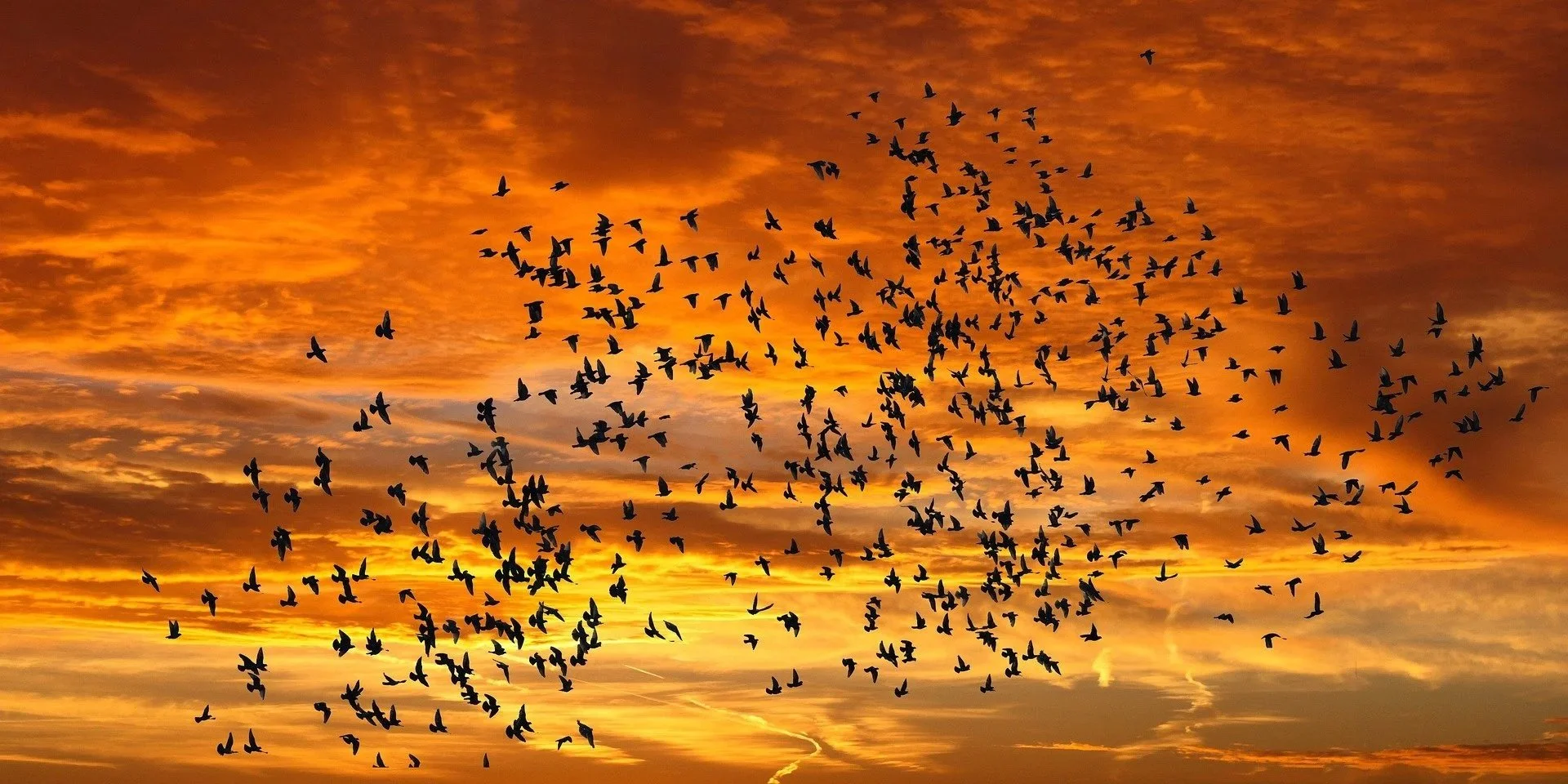
What if leadership was…a flock of birds? That is, what if leadership wasn’t a person, but an emergent, complex phenomenon, similar to a bunch of birds just deciding out of nowhere to fly together, moving as one unit, with very simple rules guiding them (e.g., don’t hit the bird to your left or right, fly forwards, not backwards). But together, they swoop and swirl in the sky creating beautiful, non-linear patterns and dynamics.
Indeed, Fairhurst notes this paradigm of viewing leadership as dynamic process - whereby it really becomes a “phenomenon generated in the [multiple, self-organising, liminal, and emergent] interactions among people acting in concert” (2007). This fundamental shift in mental models examines the liminal space, the place betwixt and between, the relationships and interactions, rather than the people and the events we traditionally viewed when thinking about leadership. It is the view that leadership is process, and not person, which “shift[s] from individual heroes to multiple heroics”, viewing even “organisations as living networked organisms” (Grint, 2010, p. 106). The beauty of this view is that, just like the flock of birds, it is constantly changing, in a continual state of evolution, repeated iterations, repeated self-organisation, repeated emergence.
With this mental model in mind, the questions we ask then do a complete 180°. Instead of brokering the discussion by asking you to picture your favourite leader, the question arises - what conditions make leadership possible? What cultural norms, relational dynamics, organisational rhythms, and constraints allow leadership to surface, be shared, and move a system forwards? Just like the birds, if leadership is emergent process, then it follows a rhythm - each cycle building on the last, with something new added each time - a swoop here, a swirl there - the flock of birds seem to dance against the backdrop of a summer’s sky. This is reminiscent of a deeper cultural truth.
Now it is true that the genius of African culture is surely its repetition, but the key to such repetition was that new elements were added each go-round. Every round goes higher and higher. Something fresh popped off the page or jumped from a rhythm that had been recycled through the imagination of a writer or a musician. Each new installation bore the imprint of our unquenchable thirst to say something of our own, in our own way, in our own voice, as best we could. The trends of the time be damned.
Thank God we’ve still got musicians and thinkers whose obsession with excellence and whose hunger for greatness remind us that we should all be unsatisfied with mimicking the popular, rather than mining the fertile veins of creativity that God placed deep inside each of us.
(Dyson, 2013, as quoted in I Stand Alone, Robert Glasper Experiment)
Will you accept “responsibility to create the conditions for collective movement towards a shared, meaningful purpose”? (CISL, 2025)
#Leadership
References
Baofu, P. (2012). The Future of Post-Human History: a Preface to a New Theory of Universality and Relativity. Cambridge Scholars Publishing. https://idiscover.lib.cam.ac.uk/permalink/f/1ii55o6/44CAM_ALMA51624228570003606
Burns, J. M. (1978). Leadership. Harper and Row.
Covey, S. R. (2009). Principle-centered leadership. Rosetta Books.
Fairhurst, G. T. (2007). Discursive leadership: in conversation with leadership psychology. Sage.
George, B. (2007). True north: discover your authentic leadership. Jossey-Bass.
Greenleaf, R. (2015). The servant as leader (Revised). The Greenleaf Center for Servant Leadership.
Grint, K. (2010). Leadership: A Very Short Introduction. Oxford University Press. https://doi.org/10.1093/ACTRADE/9780199569915.001.0001
Penn, A. (2008). Leadership Theory Simplified. http://fliphtml5.com/unva/nops/basic
Robert Glasper Experiment. (2013). I Stand Alone [Song]. On Black Radio 2. Blue Note Records.
Tucker, K., Hahn, T., Roberson, S. (2014). Your Intentional Difference: One Word Changes Everything. United States: Morgan James Publishing.
University of Cambridge Institute for Sustainability Leadership (CISL). (2025). Leadership capabilities for the 21st century: Thriving in an age of disruption. Cambridge, UK: Cambridge Institute for Sustainability Leadership. https://www.cisl.cam.ac.uk/news-and-resources/publications/leadership-capabilities-21st-century-thriving-age-disruption